Electronic leak detection. Pinpoint breaches in the membrane, even ones too small to see.
Roofcheck provides electronic leak detection and membrane integrity testing on commercial and industrial flat roofs across the UK for facilities managers, property owners, managing agents and contractors. Low and high voltage testing finds the breaches a visual check misses: failed seams, punctures, pinholes and poorly finished details, on new membranes and old ones alike.
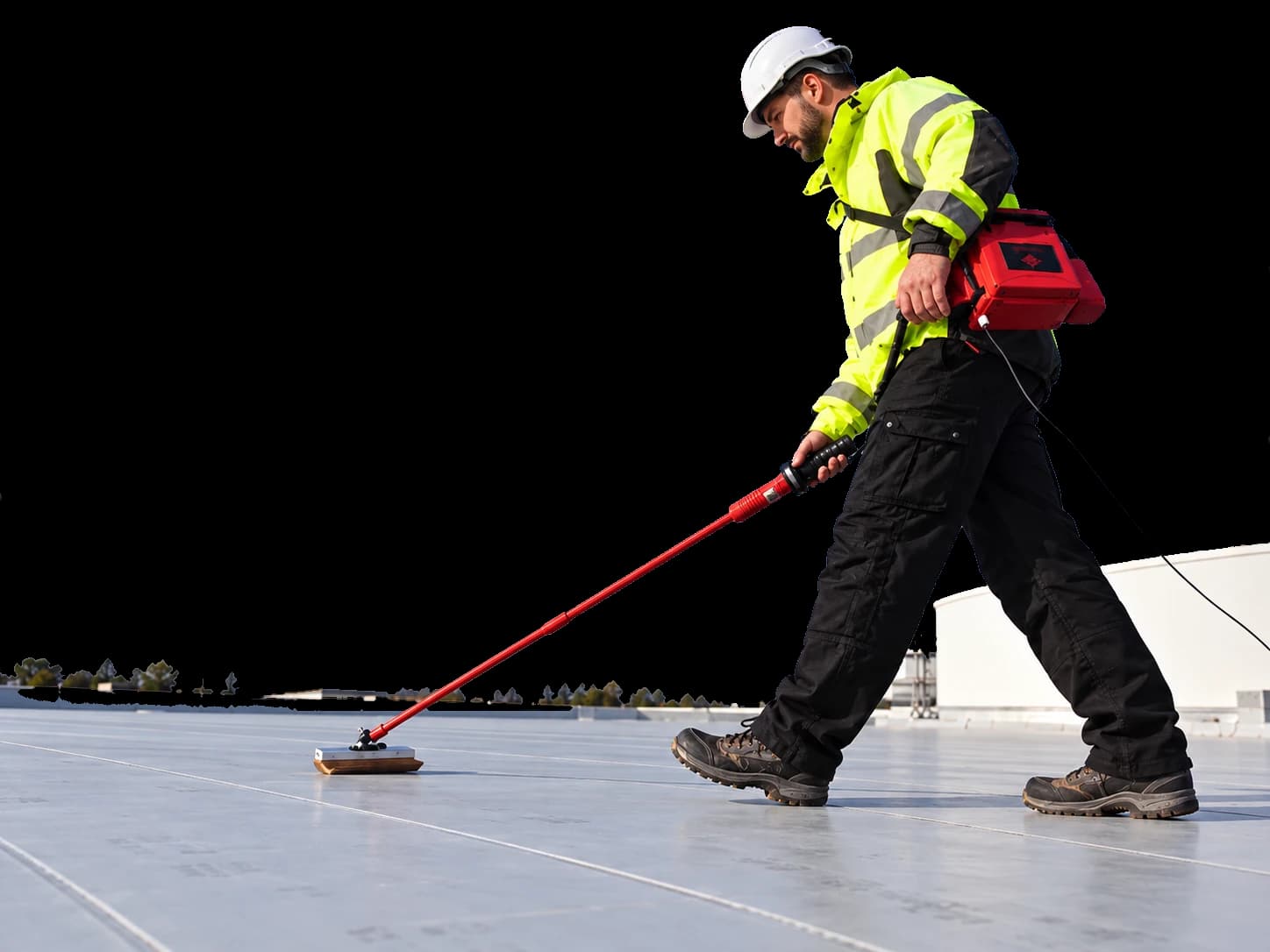
Electronic leak detection for commercial roofs
A roof membrane acts as an electrical insulator. An electrical field is applied across its surface, and wherever there is a breach, current passes through the hole to the deck below and is traced back to the exact point.
Unlike thermography or moisture mapping, it finds the breach itself rather than the moisture around it, including pinholes too small to see. It is used on new roofs before handover and on existing roofs with an active leak.
Tracing an active leak
Finds where water is getting through the membrane on an existing roof, so the repair goes in the right place.
Integrity testing before handover
Confirms a new membrane is watertight at practical completion, before responsibility for the roof changes hands.
Before warranty sign-off
Many membrane manufacturers accept or require electronic testing before a warranty is issued.
After follow-on trades
Checks for damage once other trades, such as plant, solar or services installers, have worked on the roof.
Before a covering goes on
Tests the membrane while it is still exposed, before a green roof, paving or ballast makes it much harder to reach.
Defect disputes
Gives clear evidence of membrane defects when leaks appear after handover.
What leak detection finds
It detects breaches in the membrane directly, rather than interpreting the moisture around them.
What it finds
- Pinholes and punctures in the membrane
- Failed or incomplete seams and laps
- Breaches at upstands, flashings and details
- Workmanship defects on new membranes
- Each breach marked on the roof and on a plan
Limitations
- The test works by finding a path for current through the membrane, so there has to be something conductive underneath it, such as a concrete or metal deck. Where insulation sits between the two, a conductive layer is built in or a different method is used
- Black EPDM conducts electricity, so it defeats the standard test. There are specialist methods for it, but only where the roof build-up suits them
- High voltage testing needs a dry, exposed membrane, and low voltage testing uses a wetted surface, so the method is chosen to suit the roof and the weather
- Testing through ballast, paving or a green roof is less conclusive, so it is best done before the covering goes on
- It finds the breach, not how far water has spread. Moisture mapping or thermography shows the extent
How electronic leak detection works
Pre-survey review
The deck, membrane, build-up and any coverings are reviewed to choose the right method.
Setting up
The test area is connected to earth. For low voltage testing, the surface is wetted and a conductor laid around it.
Testing
The membrane is swept or scanned, and every breach is traced to its position and marked.
Report
Breaches are recorded on a plan with photographs, online and as a PDF.
Manage your leak detection surveys online
Approve quotes, follow every survey and open reports in one place, then share them by link so everyone works from the same information.
- Breach 1
- Pinhole in a lap seam
- Breach 2
- Puncture beside a rooflight upstand
- Breach 3
- Failed seam at an outlet
A report you can act on
Every breach is located, photographed and marked on a plan of the roof.
- The method used and the surface conditions at the time of testing
- Each breach marked on a plan of the roof, with photographs
- The estimated size of each defect
- Recommendations for repair or further investigation
- Online and as a PDF
Questions about electronic leak detection
What does electronic leak detection find?
Pinholes, punctures, failed or incomplete seams and laps, breaches at upstands and flashings, and workmanship defects in the membrane.
How does it work?
The membrane acts as an electrical insulator. An electrical field is applied across its surface, and where there is a breach, current passes through the hole to the deck below and is traced back to the exact point.
Can it be carried out in wet weather?
It depends on the method. High voltage testing needs a dry, exposed membrane, while low voltage testing uses a wetted surface, so one or the other can usually be used. Your quote confirms which suits the roof.
Does it work on every roof?
The test works by finding a path for current through the membrane, so there has to be something conductive underneath it, such as a concrete or metal deck, and the membrane itself must not conduct. Where insulation sits between the two, or the membrane is black EPDM, a specialist method or a built-in conductive layer is needed.
Can you test under a green roof, ballast or paving?
Results through a covering are less conclusive, so it is best to test before it goes on. On some roofs a trace wire is installed during construction so the membrane can be tested later.
Is it used on new roofs?
Yes. On a new roof, integrity testing confirms the membrane is watertight at the points that matter: when the roofing is finished, before the building is handed over, once other trades have been across it, and before any warranty is signed off. Many manufacturers accept or require it.
Will it show how much of the roof is wet?
No. It finds the breach itself. To see how far water has spread through the build-up, it is combined with moisture mapping or thermography.
Is the test intrusive?
No. The membrane is tested electronically without cutting or lifting it.
What is needed from the client?
Safe access to the roof, an exposed membrane, and any drawings or O&M information on the deck and roof build-up.
How much does electronic leak detection cost?
Cost depends on the roof area, the method and access. Call 0113 868 0097 or start a quote online with the approximate roof area, and you’ll receive a written quote.
Get a leak detection survey
Whether you’re investigating a problem or planning ahead, we’ll help you choose the right survey for your roof. Get in touch for a free quote.
Free quote
A few details about the building and what you need to find out. It commits you to nothing.
Start your quote