Thermographic roof surveys. Find hidden moisture, heat loss and insulation defects.
Roofcheck provides thermographic roof surveys on commercial and industrial roofs across the UK for facilities managers, property owners, managing agents and contractors who need to know what is happening beneath the membrane. Infrared imaging shows where water has got in, where heat is escaping and where insulation is missing, damaged or wet.
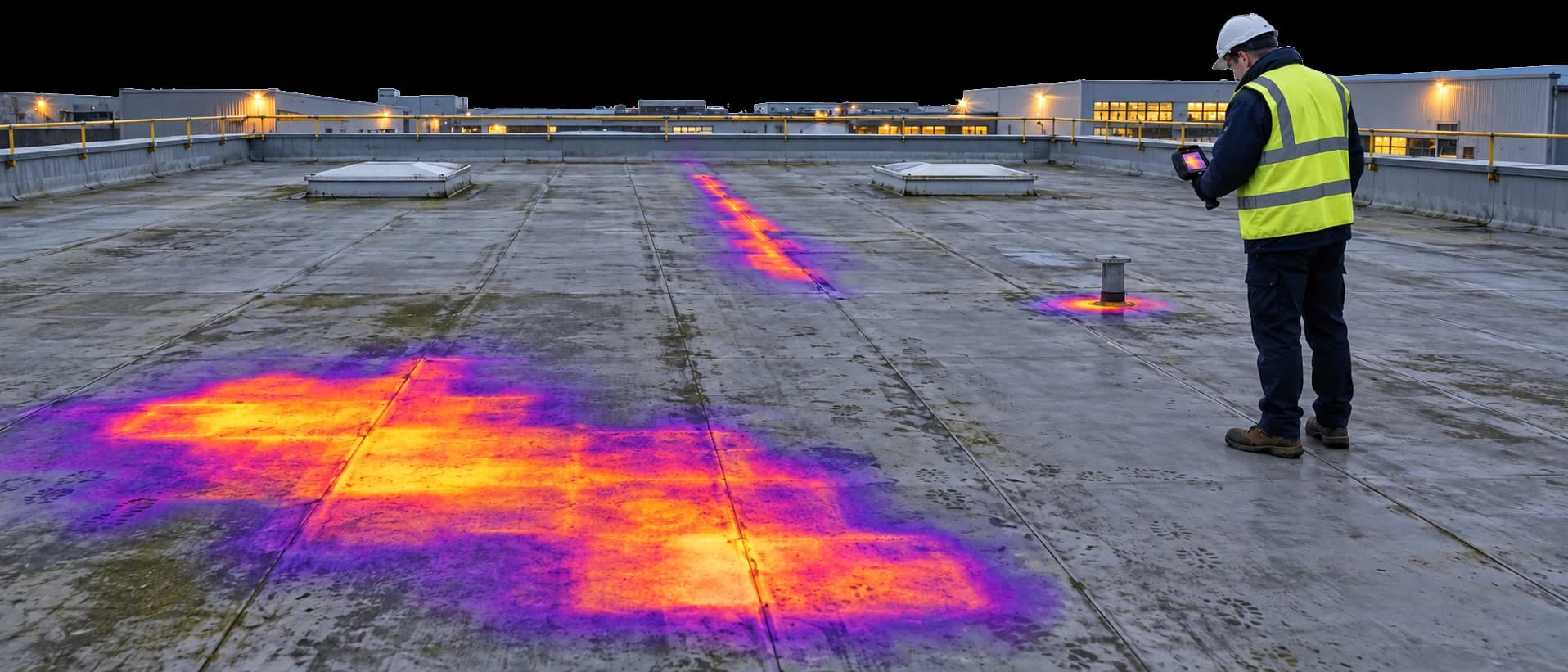
Thermographic surveys for commercial roofs
A thermographic survey reads the surface temperature of the roof to show what is happening beneath the membrane: where water has got into the build-up, where heat is escaping, and where insulation is missing, damaged or wet.
Moisture surveys are carried out after sundown following a sunny day, when wet areas hold their heat. Heat loss surveys need a cold day with the building heated, so each survey is planned around what you need to find.
Water ingress and wet insulation
Shows where water has got into the build-up and how far it has spread beneath the membrane.
Heat loss through the roof
Shows where heat is escaping, so insulation upgrades go where they make a difference.
Missing or damaged insulation
Finds gaps, damage and breaks in the continuity of the roof insulation.
Rooflights, upstands and junctions
Picks up problems around rooflights, upstands and penetrations, where water and heat often find a way through.
Before refurbishment or overlay
Maps the wet and failing areas so only what has failed is replaced.
Before solar panels go on
Checks the roof while the whole surface can still be seen and reached.
What a thermal survey shows
Warm and cold patterns on the roof point to problems beneath the membrane.
What it shows
- Water ingress and wet insulation within the build-up
- Heat loss through the roof
- Missing, damaged or discontinuous insulation
- Problems around rooflights, upstands and penetrations
- Where core samples should be taken to confirm the findings
Limitations
- Moisture surveys need a dry roof after a sunny day, and heat loss surveys need a cold day with the building heated, so both are planned around the weather
- Thermal patterns can also come from plant exhausts, internal heat sources or changes in the build-up, so moisture findings are confirmed with core samples
- It works best where there is a single layer of insulation beneath the membrane. Roofs with several layers, and reflective or metal roofs, are harder to read, and moisture mapping may suit them better
- It does not always show where water gets in. Where the breach needs pinpointing, it is combined with electronic leak detection
How a thermographic survey works
Pre-survey review
Drawings, the roof build-up and what you need to find are reviewed, and the survey is planned for the right conditions.
Thermal scan
The roof is scanned with an infrared camera in the conditions the survey needs.
Marking and cores
Findings are marked out on the roof, and moisture is confirmed with core samples.
Report
Thermal images and findings are issued online and as a PDF.
Manage your thermographic surveys online
Approve quotes, follow every survey and open reports in one place, then share them by link so everyone works from the same information.
- Area A
- Warm pattern, wet insulation confirmed by core
- Area B
- Heat loss at a rooflight upstand
- Area C
- Explained by a plant exhaust, not a defect
A report you can act on
Every finding is shown in thermal images and marked on a plan of the roof.
- Thermal and visual images of every finding
- Findings marked on a plan of the roof
- Core sample results where cores are taken
- Weather conditions recorded before and during the survey
- Online and as a PDF
Questions about thermographic surveys
What can a thermographic roof survey find?
Water that has got into the roof build-up, wet insulation, heat loss, missing or damaged insulation, and problems around rooflights, upstands and other junctions.
How does it find moisture?
On a sunny day, wet insulation absorbs and stores more heat than dry insulation. After sundown it cools more slowly, so wet areas show up as warm patterns on an infrared camera.
When can a thermographic survey be carried out?
Moisture surveys need a dry roof after a clear, sunny day, so in the UK they are usually carried out between April and September. Heat loss surveys need a cold day with the building heated, usually between September and May.
Are the findings confirmed?
Yes. Thermal patterns can also come from plant exhausts, internal heat sources or changes in the build-up, so moisture findings are confirmed with core samples.
Will the survey locate the leak?
It often shows where water is getting in, particularly around rooflights and upstands, but not always. Where the breach needs pinpointing, it is combined with electronic leak detection.
Is thermography suitable for every roof?
It works best on flat, non-metallic roofs with a single layer of insulation beneath the membrane. Roofs with several layers, and reflective or metal roofs, are harder to read, and your quote will recommend moisture mapping or another method if so.
Can it be combined with other surveys?
Yes. It is often followed by core sampling to confirm the findings, electronic leak detection to find the point of entry, or moisture mapping on roofs with several layers of insulation.
Is the survey intrusive?
The thermal scan is not. Core samples remove small sections at agreed locations, which are sealed afterwards, and any roof warranty is checked before cores are taken.
What is needed from the client?
Safe access to the roof, the building heated for heat loss surveys, details of any rooftop plant or internal heat sources, and any drawings or O&M information on the roof build-up.
How much does a thermographic survey cost?
Cost depends on the roof area, access and the number of core samples. Call 0113 868 0097 or start a quote online with the approximate roof area, and you’ll receive a written quote.
Get a thermographic survey
Whether you’re investigating a problem or planning ahead, we’ll help you choose the right survey for your roof. Get in touch for a free quote.
Free quote
A few details about the building and what you need to find out. It commits you to nothing.
Start your quote