Moisture mapping surveys. Non-destructive testing for moisture trapped within the roof build-up.
Roofcheck provides moisture mapping surveys on commercial and industrial roofs across the UK for facilities managers, property owners, managing agents and contractors who need to know where water is trapped in the roof. Non-destructive readings, calibrated against core samples, show which areas can be retained and which need removing.
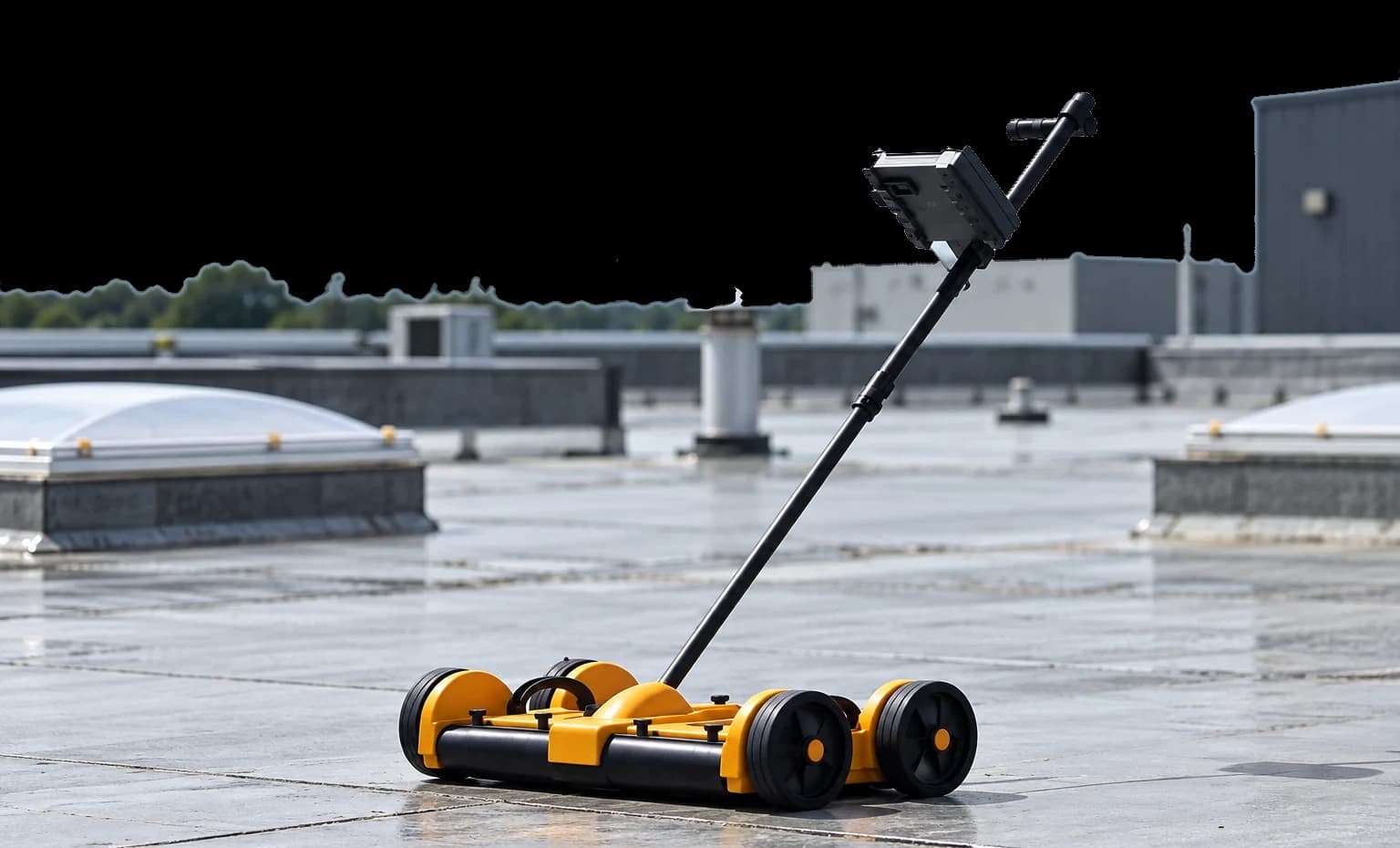
Moisture mapping for commercial roofs
A leak and the damp it causes are often yards apart. Once water is through the membrane it travels along the insulation and the deck, soaking a wide area while the ceiling below still looks dry.
Moisture mapping takes readings across the whole roof and plots them on a scaled drawing, so the wet areas can be removed and the dry areas kept rather than stripping the whole roof.
Before refurbishment or overlay
Shows which areas can be retained and which need removing, so the specification sets out areas for retention, partial removal or full replacement.
Roofs that have been overlaid
Older roofs often carry several layers of insulation and earlier waterproofing. Moisture mapping tests through the build-up, where a visual inspection cannot see.
After leaks or water ingress
Water spreads through a roof build-up well beyond the point of entry. Mapping defines the full extent of the affected area.
After storms and severe weather
Checks whether water has got into the build-up after storm damage, before it causes problems inside the building.
Planned maintenance and budgeting
A record of where moisture is held gives a defined scope of works and a baseline to compare against in future.
Before solar panels go on
Shows whether the roof needs work first, while it can still be reached.
See through every layer
Readings reach into the insulation, earlier waterproofing and, on some roofs, the deck.
What it establishes
- Moisture held within the insulation
- Moisture trapped between earlier layers of waterproofing
- Moisture within some decks and supporting structures on uninsulated roofs
- The extent of each wet zone, plotted on a scaled drawing
- Zones for retention, partial removal or full replacement
Limitations
- It shows where moisture is held, which is not always the point of entry. Where the breach needs locating, it is often combined with electronic leak detection
- Surface scanning methods need a dry roof, so the survey is scheduled around the weather
How a moisture mapping survey works
Pre-survey review
Drawings, O&M information and access are reviewed, and the method is chosen to suit the build-up.
Grid readings
Readings are taken on a regular grid across the roof, typically around two metres apart.
Core samples
Cores from low and high reading points set a baseline and confirm the build-up.
Report
Findings and recommendations are issued online and as a PDF.
Manage your moisture mapping surveys online
Approve quotes, follow every survey and open reports in one place, then share them by link so everyone works from the same information.
- Wet zone A
- about 90 m², remove
- Wet zone B
- about 35 m², remove
- Core 1
- Wet, insulation and lower layer
- Core 2
- Wet insulation
- Core 3
- Dry, retain
A report you can act on
Wet zones are plotted to scale, with a recommendation for each area.
- Moisture readings plotted on a scaled drawing of the roof, with wet zones clearly marked
- Core sample results with photographs
- Recommendations for retention, partial removal or full replacement
- Online and as a PDF
Questions about moisture mapping
What does moisture mapping detect?
Moisture trapped within the roof build-up: in the insulation, between earlier layers of waterproofing on roofs that have been overlaid, and within some decks and supporting structures on uninsulated roofs.
Which survey method is used?
The two main methods are electrical capacitance or impedance scanning, which takes readings from the roof surface, and nuclear moisture gauges, which measure moisture to a greater depth. The method depends on the roof build-up, and your quotation confirms which is proposed.
Does it work on roofs that have been overlaid?
Yes. It tests through multiple layers of insulation and earlier waterproofing, which makes it well suited to roofs that have already been overlaid.
Can it be carried out in wet weather?
Surface scanning needs a dry roof, so it is scheduled around the forecast. The quotation sets out any weather requirements for the method proposed.
Will the survey locate the leak?
Moisture mapping shows where moisture is held in the roof, which is not always where it entered. Where the breach needs locating, it is often combined with electronic leak detection.
Can it be combined with other surveys?
Yes. It is often paired with electronic leak detection to find the point of entry, with thermography across large roofs, and with core sampling to confirm the build-up.
Is the survey intrusive?
The readings are non-destructive. Core samples remove small sections at agreed locations, which are sealed afterwards. Any roof warranty is checked before cores are taken.
What is needed from the client?
Safe access to the roof for the surveyor and equipment, and any drawings, O&M information or history of repairs and overlays. The equipment is bulky, so internal stairs, a hatch or a lift are preferable.
How much does a moisture mapping survey cost?
Cost depends on the roof area, the build-up and the number of core samples. Call 0113 868 0097 or start a quote online with the approximate roof area, and you’ll receive a written quote.
Get a moisture mapping survey
Whether you’re investigating a problem or planning ahead, we’ll help you choose the right survey for your roof. Get in touch for a free quote.
Free quote
A few details about the building and what you need to find out. It commits you to nothing.
Start your quote